

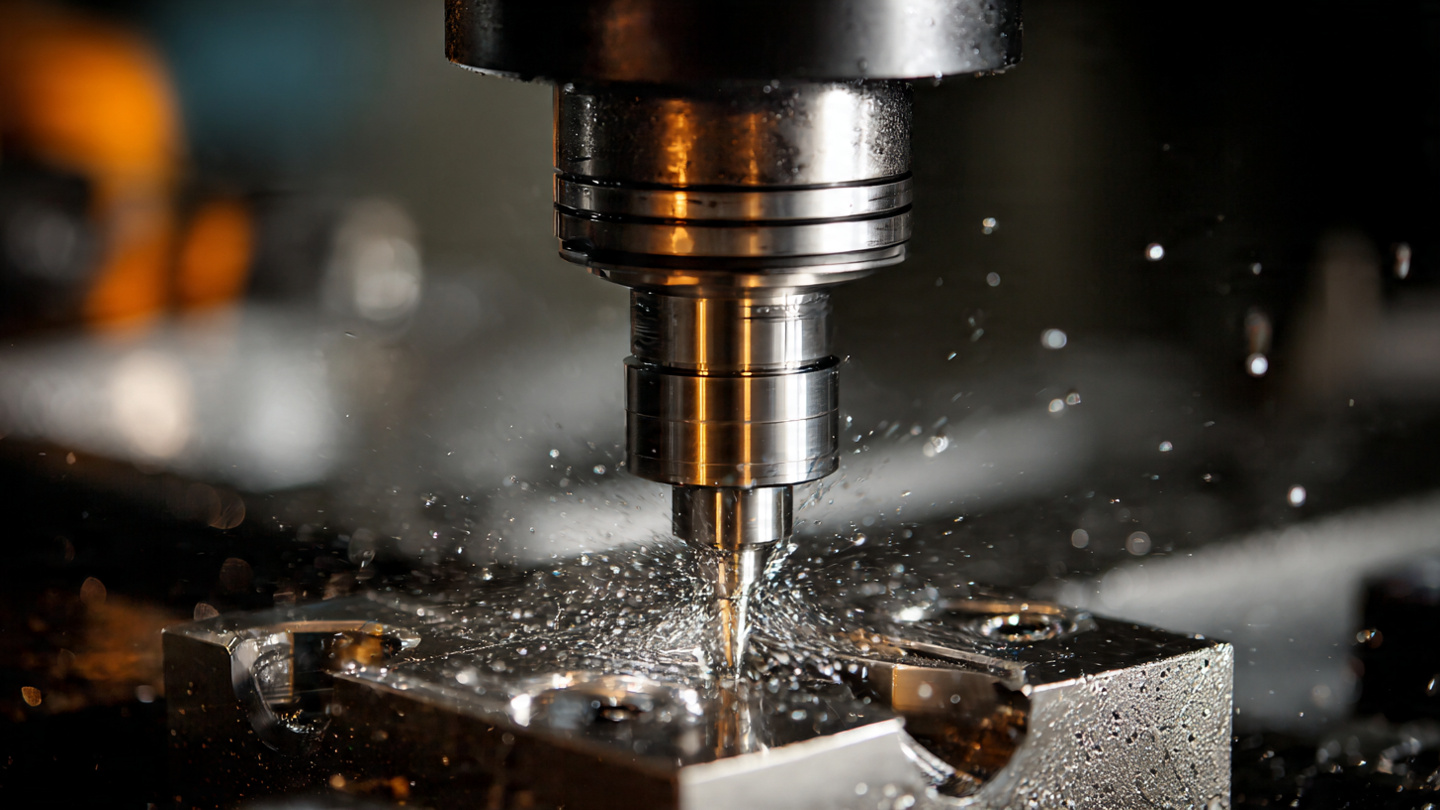
Using a conventional drill or milling spindle often means rearranging a workpiece multiple times just to reach an angled bore or side hole. But what if you could simply redirect the spindle’s power — rotating the cutting tool at a precise angle — without ever unclamping the part? That’s exactly what a Winkelbohrspindel makes possible. In this article, you’ll learn how this often-overlooked angle‑drilling spindle can save you time, boost machining accuracy, and expand what your existing CNC machines can do.
What is a Winkelbohrspindel?
At its core, a Winkelbohrspindel is an “angle head” — a spindle attachment that redirects rotational power from the main machine spindle to a tool axis set at a fixed or adjustable angle, most commonly 90 degrees. The German name breaks down cleanly: “Winkel” (angle), “bohr” (drill), “spindel” (spindle). Rather than drilling straight, your tool can approach from the side or at a tilt.
Inside the housing, a set of precision bevel or hypoid gears reroutes the torque, while high‑quality bearings and a stable tool interface — often ER collets or standard machine tapers such as HSK or BT — ensure rotational stability. Some designs even include through‑spindle coolant channels to support deep drilling or tapping under demanding conditions.
You could call it an adapter — but that undersells it. A properly engineered Winkelbohrspindel transforms your machines; what once demanded multiple setups or even additional machines becomes a one-step operation.
Why modern shops rely on Winkelbohrspindel for efficiency and precision
Imagine you run a small CNC shop making hydraulic manifold blocks. Traditionally, if you need cross‑holes or side-drilled holes, you might clamp the part, drill vertically, then reclamp on another face, drill again — a time-consuming process. A colleague of mine at an automotive‑parts workshop told me they cut cycle time by roughly 35% once they switched a batch job to angle‑head drilling. They never reclamped a single part.
The magic lies in what the Winkelbohrspindel enables: side machining without reclamping. That not only reduces setup time — but also preserves positional accuracy because the datum surfaces stay fixed throughout the operation.
Fewer setups mean less opportunity for error. Less reclamping leads to repeatable tolerance adherence, fewer rejects, and better throughput. For industries like automotive, aerospace, hydraulics, or mold-making, where every precision hole matters, an angle spindle isn’t a luxury — it’s a strategic asset.
Moreover, a Winkelbohrspindel expands what a 3‑ or 4‑axis mill can do. Why invest in a full 5-axis machine when a precision angle head accomplishes many angled tasks more affordably? Many manufacturers now view angle heads as essential productivity tools rather than optional accessories.
How to choose the right Winkelbohrspindel for your machine
Not all Winkelbohrspindeln are created equal — and picking the wrong one can hurt performance as much as not having one. First, consider the interface. Most modern CNC machines rely on standard tapers such as HSK, BT, or CAT. Your angle head must match that taper for rigidity and to ensure proper tool-holding.
Next, examine what you need it for. If you routinely drill side holes at the same 90° angle, a fixed-angle head is often the most rigid and cost-effective. But if you face components with varying angular requirements — angled bores, tapered channels, or odd orientations — an adjustable-angle head (0–90°, or more) is more versatile, though usually a bit more expensive and slightly less rigid.
Also check output specifications: maximum RPM, torque, run-out tolerances, coolant compatibility. For example, if you plan heavy tapping or pocket milling, favour a head with higher torque and supported bearings. For fine drilling or finishing with small tools, high-speed heads with low run-out are ideal.
Finally, account for machine envelope and clearance. Angle heads add length or width to your spindle. Ensure there’s no interference with fixtures, clamps, or the tool magazine. Overhang and extra mass can affect balance, so quality heads are balanced to standards (e.g. ISO 21940) and sometimes require support arms for heavy loads.
Integration, maintenance and avoiding pitfalls
Adding a Winkelbohrspindel isn’t “plug and play” — at least not if you want long-term precision and reliability. First step: proper installation. Ensure the head is seated firmly in the spindle, properly aligned, and balanced. Any wobble or misalignment can quickly degrade hole quality.
Next: coolant and chip management. For deep drilling or tapping, through‑spindle coolant helps maintain tool life and flush chips. Without it, chips can clog, bearings may overheat, and wear accelerates.
Maintenance matters. Check bearings, seals, and gear teeth regularly. Clean out chips after each batch. If you hear odd noises or feel vibration — stop and inspect immediately. Many angle-head manufacturers recommend a checkup every few hundred hours or after any accidental impact.
Watch tool stick-out too. The longer your tool protrudes from the output spindle, the less rigid the setup becomes — which can lead to chatter or deflection, especially under heavy loads. Short, rigid tools are better. For deep or high-load tasks, consider reducing feed or depth-of-cut.
And finally — plan for spindle magazine constraints. Some angle heads exceed size or weight limits for ATC (automatic tool change) systems. If that’s the case, you may need to load them manually, which adds a bit of time. But in many jobs, that extra minute is easily offset by the time saved from eliminating multiple setups.
Overcoming common objections: Is it really worth the cost and complexity?
You might be thinking: “Why spend on an angle head when we could just buy a full 5‑axis machine?” That’s a fair question. But for many shops, especially small-to-medium ones, a Winkelbohrspindel delivers most angled drilling/milling capabilities for a fraction of the cost. The entry price is far lower than a 5-axis retrofit, and with proper use, you still get precision and repeatability.
Another objection: “Angle heads add complexity — more maintenance, risk of vibration.” True — but only if you skimp on quality or ignore maintenance. A well-designed Winkelbohrspindel, properly installed and maintained, typically performs reliably for hundreds — if not thousands — of parts before requiring service. For many, the time saved per part quickly pays back the cost.
Conclusion: Why every shop should consider a Winkelbohrspindel
If you want to drill angled holes, tap threads, or mill pockets in difficult-to-reach places — and do so repeatedly with precision — a Winkelbohrspindel transforms your existing CNC machine into a more flexible, efficient production tool. No more time wasted reclamping; no more juggling fixtures; no more compromise on accuracy.
Think back to that batch job with weird angled holes — wouldn’t it have been great to finish it in one clamp? With a Winkelbohrspindel, you can. Whether you’re running a small shop or managing a busy manufacturing floor, the angle head offers a high return on investment, often in the very first job.
If you found this useful, go ahead and share it, leave a comment with your experience, or check out our tips on CNC machining and cutting tool selection. Your next angled bore might just be your quickest and most accurate yet.
Read Also: UAC3600816: The Technology Revolutionizing Tech Startups
FAQs for Winkelbohrspindel
1. What is a Winkelbohrspindel?
A Winkelbohrspindel is an angle head spindle that allows CNC machines to drill or mill at precise angles.
2. How does a Winkelbohrspindel improve machining efficiency?
It reduces multiple setups, allowing angled holes or side drilling in a single operation, saving time and effort.
3. What types of Winkelbohrspindel are available?
There are fixed-angle heads for standard angles and adjustable-angle heads for versatile machining requirements.
4. Which machines are compatible with a Winkelbohrspindel?
Most CNC mills and machining centers with standard tapers, like HSK, BT, or CAT, can use an angle head.
5. How do you maintain a Winkelbohrspindel?
Regularly clean chips, check bearings, inspect gears, and ensure proper lubrication for long-lasting precision.
6. What industries commonly use Winkelbohrspindeln?
Automotive, aerospace, mold making, and hydraulic parts manufacturing rely on angle heads for accurate, repeatable drilling.
7. Are Winkelbohrspindeln worth the investment?
Yes, they save setup time, improve accuracy, and expand CNC machine capabilities, often paying for themselves quickly.

